



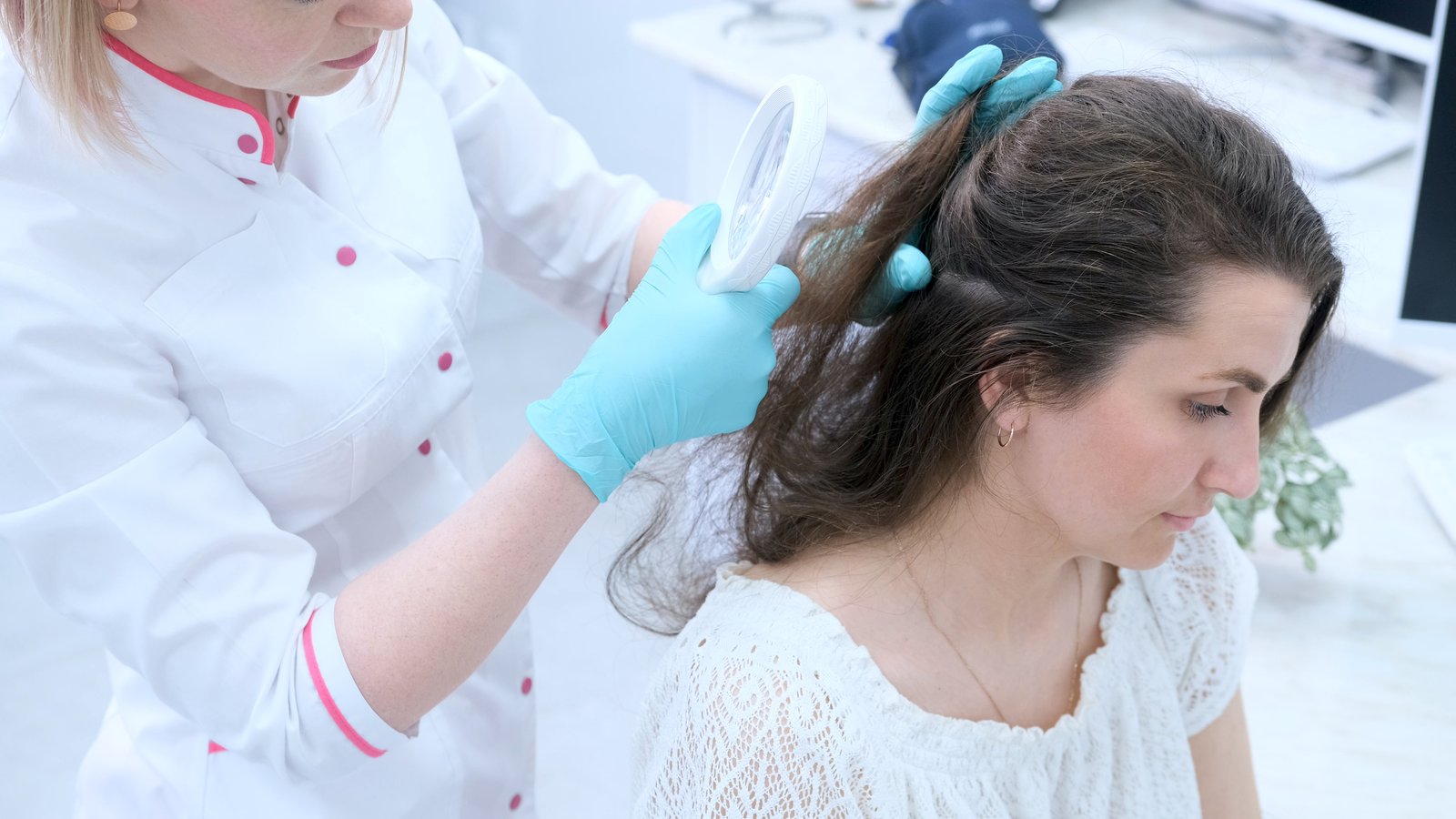
Flaking that shrugs off every anti-dandruff shampoo you try may not be dandruff. Psoriasis on the scalp can look very similar, and the American Academy of Dermatology says as much — scalp psoriasis "can look a lot like dandruff". The difference is in the scale itself, and it matters, because the two conditions are treated differently.
The Tell: Silvery Scale
The AAD draws the distinction directly: unlike dandruff, scalp psoriasis causes a silvery sheen and dry scale on the scalp. Alongside that you may see:
- Reddish patches on the scalp — some barely noticeable, others thick, inflamed and very obvious.
- Dandruff-like flaking with that silvery-white scale.
- Dryness severe enough that the skin cracks and bleeds.
Two more clues that point away from dandruff: psoriasis patches tend to have a defined edge rather than a general dusting, and they often do not respect the hairline — extending onto the forehead, the back of the neck or behind the ears.
The quickest practical test is your own history. Dandruff usually responds to an anti-dandruff shampoo. Flaking that has not budged after several weeks of the right shampoo is worth having looked at properly.
What Scalp Psoriasis Feels Like
Itch is the symptom most people lead with. The AAD describes it as ranging from mild to intense enough to interfere with everyday life and cause sleepless nights. It also lists a burning sensation or soreness, and bleeding — because the scalp can be very itchy and scratching makes it bleed.
That itch-scratch loop is where the real damage happens. Scratching the scalp or using force to remove scale can cause hair loss. The reassuring half of that sentence, also from the AAD: after the scalp psoriasis clears, hair usually regrows. Protecting your hair means treating the psoriasis, not attacking the scale.
Why It Happens
Psoriasis is not a hygiene problem and it is not contagious. Bakersfield Dermatology describes it as a chronic condition in which the immune system sends out incorrect signals that cause skin cells to grow too quickly: white blood cells called T cells attack healthy skin as if fighting an infection, new cells reach the surface far faster than normal, and because dead skin cannot shed quickly enough, thick scaly areas build up.
An estimated 7.5 million Americans have psoriasis, most commonly first appearing between ages 15 and 35. The scalp is one of the places it turns up, and someone with scalp involvement often has patches elsewhere — elbows, knees or trunk are the usual sites.
The practice also lists what tends to set off flares: certain medications, damage to the skin such as cuts, scrapes or burns, diet, excessive alcohol use, infections such as strep throat, smoking, stress and weather.
How It Is Treated
A dermatologist diagnoses psoriasis by examining the skin, nails and scalp, and sometimes by taking a small skin sample to look at under a microscope. Treatment is then built around severity:
- Medicated shampoos and solutions. The AAD notes some people get relief from these, and that a few are available without prescription.
- Prescription topicals applied to the scalp, often alongside a scale softener to let the medication reach the skin.
- Light treatment. Targeted phototherapy is used for stubborn plaques — the practice offers the XTRAC® laser, and the AAD notes the excimer laser can safely treat children and adults with psoriasis on the scalp, ears, armpits, groin or buttocks.
- Medication that works throughout the body, for more severe or resistant disease.
The limitations worth stating: psoriasis is chronic, and anyone who has it lives with a cycle of flare-ups and remissions. Treatment controls it rather than curing it. Light treatment carries its own considerations — the AAD lists a sunburn-like reaction, mild stinging or burning and dark spots as immediate effects, with freckling, early skin ageing and an increased risk of skin cancer over the long term — which is why it is prescribed and monitored rather than open-ended. The encouraging counterweight, also from the AAD: with a dermatologist's help, it is unusual for anyone to struggle to control scalp psoriasis for long, even when it is severe.
Get Persistent Flaking Looked At
Bakersfield Dermatology & Skin Cancer Medical Group treats psoriasis at 4100 Empire Drive, Suite 120, Bakersfield, CA 93301, with additional offices in Porter Ranch, Valencia and Palmdale. If your scalp has been flaking, itching or sore despite shampoo, call 866.903.3376 or request an appointment.
Frequently Asked Questions
How do I tell scalp psoriasis from dandruff?
The American Academy of Dermatology points to the scale: unlike dandruff, scalp psoriasis causes a silvery sheen and dry scale on the scalp. Psoriasis patches also tend to be well-defined and can extend past the hairline onto the forehead, neck or behind the ears.
Will my hair grow back?
Usually. The AAD notes that scratching the scalp or using force to remove scale can cause hair loss, and that after the scalp psoriasis clears, hair usually regrows. The way to protect your hair is to treat the psoriasis rather than pick at the scale.
Can I treat it with shampoo from the pharmacy?
Sometimes. The AAD notes some people get relief from a medicated shampoo or solution, a few of which are available without prescription. If that is not enough, a dermatologist can prescribe stronger treatment including light treatment or medication that works throughout the body.
Is scalp psoriasis contagious?
No. Bakersfield Dermatology describes psoriasis as a non-contagious chronic condition in which the immune system sends incorrect signals that make skin cells grow too quickly. You cannot pass it to anyone, including through shared hairbrushes or hats.
Sources: American Academy of Dermatology, Scalp Psoriasis: Symptoms — that it can look a lot like dandruff, the silvery sheen distinction, reddish patches, cracking and bleeding, itch severity, and hair loss from scratching with regrowth after clearing; AAD, Psoriasis Treatment: Phototherapy — excimer laser use on the scalp and other sites, and the short- and long-term side effects; and Bakersfield Dermatology's own Psoriasis page — the 7.5 million figure, the T-cell mechanism, typical age of onset, common sites and the trigger list.